How to Use AI Simultaneous Interpretation?
EventCAT Conference Onboarding Guide: How to Set Up AI Simultaneous Interpretation in 10 Minutes
EventCAT Conference is an AI-powered simultaneous interpretation solution that can be started directly from a web browser without the need to install a separate app. By signing up via email, you can experience it for free for 10 minutes.
This guide will walk you through the necessary steps for getting started, such as basic setup, language selection, creating conference rooms, displaying subtitles, and saving transcripts.
It includes methods for setting up and operating events for customers who already have a subscription, as well as for those who haven't purchased a subscription yet, offering a 10-minute free trial.
You can get started immediately with the method that fits your current situation. We also introduce important setup points to check before starting for more accurate translations.
1. Create an EventCAT Account
To use EventCAT, you need to first create an account.
Sign up by entering your email address and basic information, and then enter the one-time authentication code (OTP) sent to your email to complete email verification.
If you already have an EventCAT account, simply log in and proceed to the next step.
Frequently Asked Questions: Didn’t receive the email?
Verify that the email address you entered is correct.
Refresh your inbox.
Check your spam or junk folder.
If you still can’t find the email, refer to What to Do if You Didn't Receive the OTP Email After Signing Up for EventCAT.
2. Check Your Conference Subscription
Before starting your conference setup, make sure you have the right subscription for your event. Depending on the type of pass, the usage time and features may vary. It’s a good idea to check if your pass fits your event schedule and operational needs.
If you already have the right pass, proceed to the next step. If additional purchases are required or you're unsure about which pass to choose, check the pass page or refer to the related documentation.
Important Note:
Half-day, All-day, and All-day MAX passes: Time is deducted from the moment you click "Start Session". Time will not stop if you click "End Session". You cannot split the 6-hour or 24-hour passes across multiple days. For hourly use, use a Prepaid pass.
If you need custom guidance based on your event size or setup, please contact us at contact@eventcat.com.
Helpful Related Documents:
3. Create Your Conference and Sub-Sessions, and Apply the Pass
Understanding Conference Structure:
EventCAT Conference is structured as follows:
Conference: The overall event unit (e.g., International Forum, Seminar).
Conference Room: A unit by date or location (e.g., Day 1, Room A).
Session: The actual presentation or program unit.
Example:
Conference Name: Global AI Forum
Conference Room: Day 1 / Main Hall
Sessions: Opening Ceremony, Keynote1, Keynote2, Panel Discussion
1. Creating a Conference
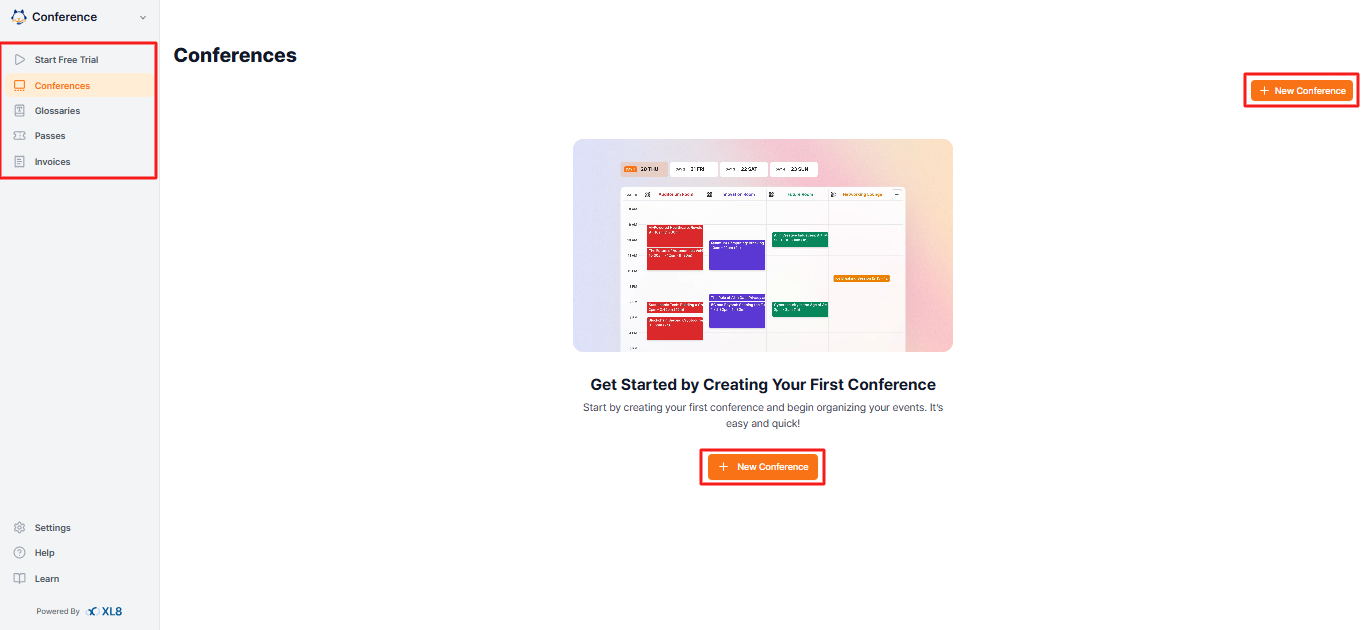
A conference is the space where you prepare and operate the actual event. You can handle all the necessary preparations before the event begins, including session creation, language settings, applying passes, and setting up real-time captions.
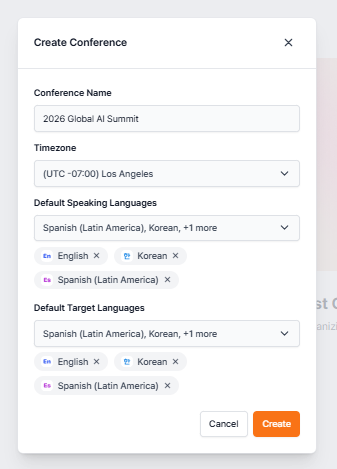
Enter the Conference Room Details
Enter the following information for this conference room:
Conference Name
Time Zone
Default Source Language
Default Target Language
Once you’ve completed the information, click Create to save the conference.
2. Set Up Sessions, Glossaries, Languages, and Audio
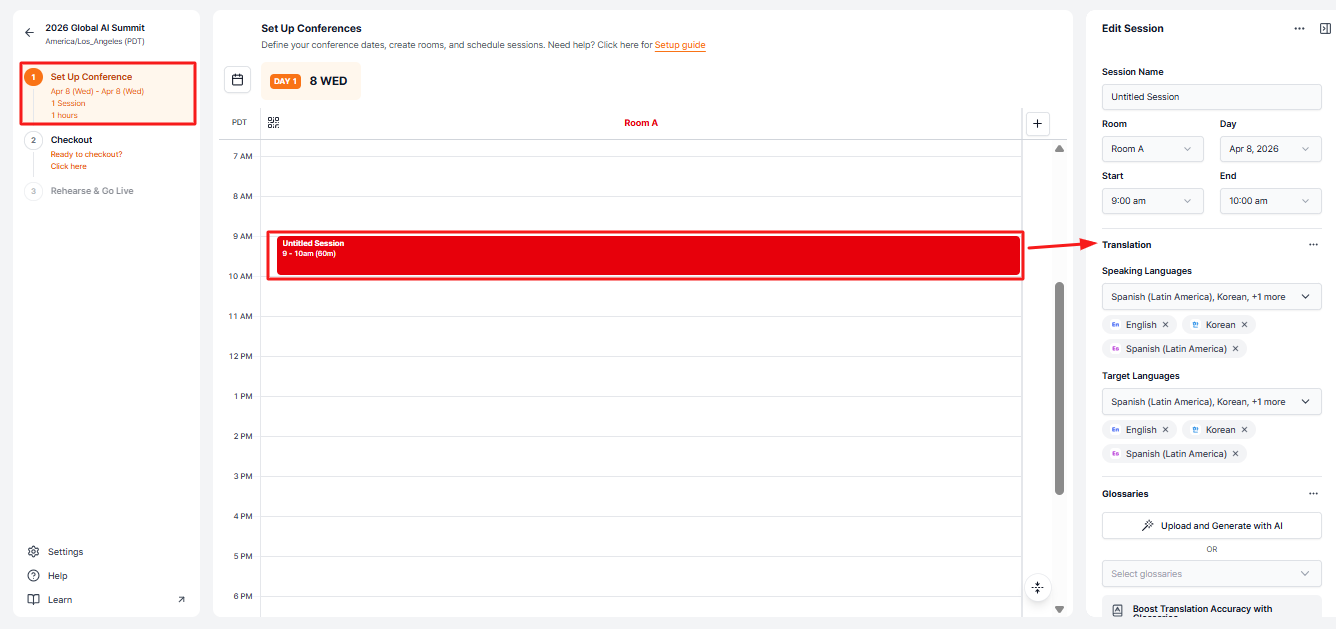
Inside the created conference, add sessions according to the event schedule. You can set the language and audio environment for each session.
Tip: Structuring the sessions to match the actual event schedule will make management much easier.
For detailed language and audio setup instructions, refer to the guide below.
3. Applying Passes
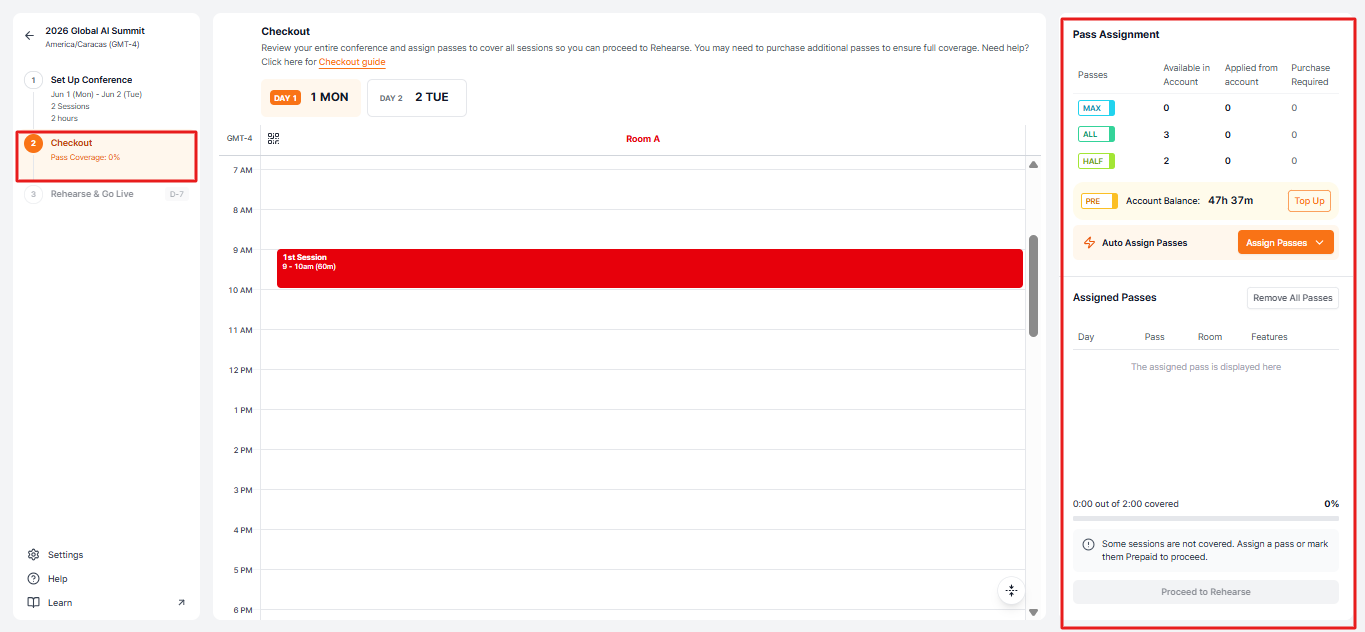
Once the sessions are ready, review the Pass Assignment panel to make sure all sessions are covered.
You can see:
Available passes
Passes applied from the account
Purchase required
Coverage status
Regular passes can be assigned automatically or manually.
Note: Prepaid doesn’t require manual assignment. It can cover multiple rooms or conferences as long as the account has valid payment coverage and a registered payment method.
Important: To rehearse or go live, all sessions must be fully covered.
Related Article: Conference Quick Checkout Guide – Pass Setup and Coverage
4. Managing Glossaries, Languages, and Audio from the Controller
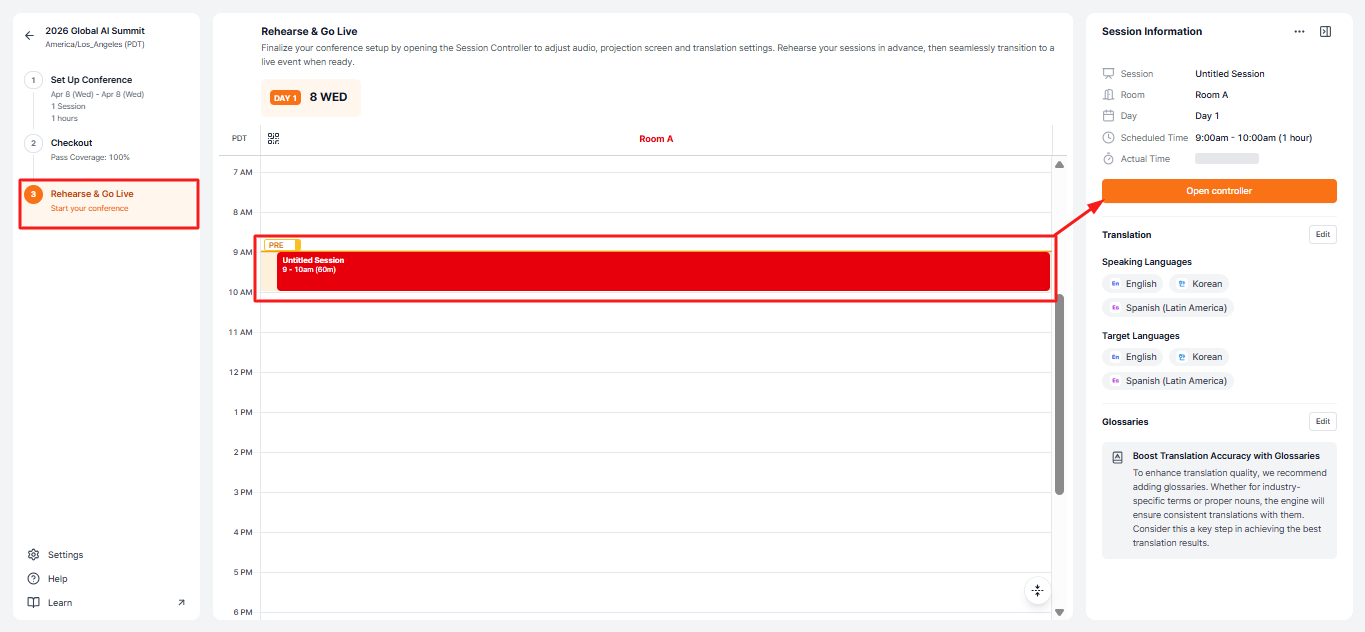
The Controller is the page where you can manage key settings and progress before and during the event. From here, you can check glossary application status, source and subtitle languages, audio input status, and also quickly view the URL and QR code to share with participants.
Items You Can Check and Set in the Controller
On the left sidebar, you can use the following features:
Language & Glossary: Check the source language, subtitle language, and glossary application status.
Participant Access Info: Share the URL and QR code for participants to view subtitles on their personal devices.
Live View: Open the subtitle screen that will be shown on-site.
Live View Customization: Apply company or event logos and edit fonts.
STT Revise Guide: Add instructions before the session starts to improve transcription accuracy, such as speaker names, event terms, or topic context.
Session Edit: Change session settings such as language and glossary.
On the right sidebar, you can use the following features:
Audio Input Settings: Select the microphone to use and check the input status.
Session Start: Start real-time subtitles.
After Session Ends: Download the transcript and create session summaries.
Why Glossary, Language, and Audio Settings Are Important
To achieve more accurate AI simultaneous interpretation, it’s essential to review the glossary, language, and audio settings before the event starts.
The glossary helps to increase translation accuracy by pre-registering frequently used terms such as names, company names, product names, and industry-specific terminology. By adding key terms based on presentation materials or event agendas, it reduces mistranslation of proper nouns or specialized terms.
The source language is the language spoken by the presenter, while the subtitle language is the language provided for translation to the audience. Setting the correct source language ensures better speech recognition and more stable translation quality.
Audio input quality directly affects real-time captions and translation accuracy. In the Audio Input panel of the Conference Session Controller, you can select the appropriate microphone and use the live scrolling volume and noise graph to monitor the audio signal over time.
The Mute option temporarily prevents microphone audio from reaching the translation stream while keeping the audio connection active. The Listen option allows you to monitor the current microphone input through a selected output device. Audio monitoring remains off until an output device is selected, helping prevent feedback or echo.
Before starting the event, confirm that the correct microphone is selected and check the live graph to ensure that the speaker’s voice is being captured clearly. When using an external microphone, verify its connection. When using a built-in microphone, place the device closer to the speaker to improve sound clarity.
Important Notes
To change language or glossary settings during the session, you must first end the session and then make the edits.
After making changes, restart the session and refresh the controller page and live view page for the changes to take effect.
For more accurate subtitles, a quiet environment and stable microphone are recommended.
A stable internet connection is necessary for smooth real-time subtitle delivery.
5. Test the Event in Rehearsal Mode on the Controller Page
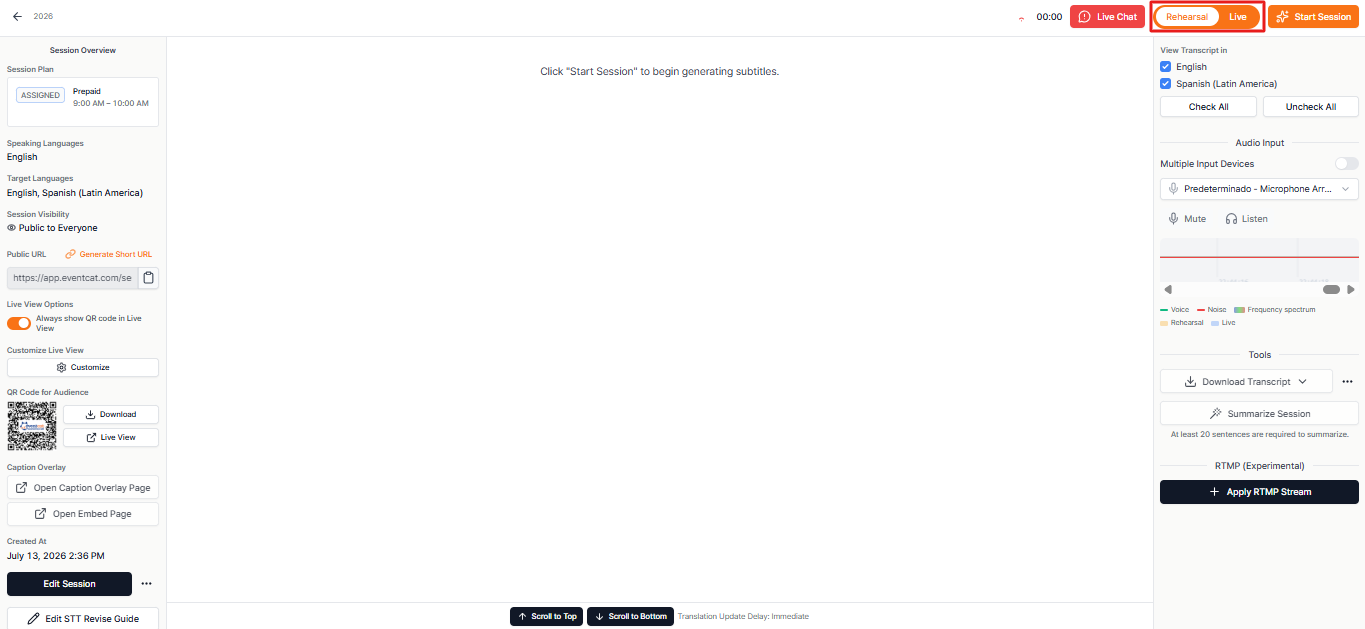
Once all conference settings, sub-sessions, pass applications, glossary, audio, and language settings are complete, you can now start the rehearsal with the same setup environment as the actual event.
In rehearsal mode:
You can test all the features in an environment identical to the real event, without deducting any pass time.
We highly recommend running a rehearsal first for smooth AI interpretation usage.
Operating the Event from the Controller
Once the session starts, you can manage the entire event from the controller screen.
On the left side, you can access session details, Live View options, the QR code, Caption Overlay, and the STT Revise Guide.
On the right side, you can manage transcript languages, audio input settings, additional tools, and RTMP streaming options.
If an external microphone is unavailable, you can use the device’s built-in microphone. For better transcription and translation accuracy, place the device close to the speaker and confirm that the audio input is clear.
Setting the Languages Displayed in Live View
Once the session begins, use the language selector dropdowns in the footer of the Live View screen to choose the languages displayed on the on-site screen.
When a session has exactly two target languages, two additional options are available:
Spoken Language: The selected panel automatically displays the language currently being spoken.
Translated Language: The selected panel automatically displays the translation in the other configured language.
For example, when Korean and English are configured, and Translated Language is selected, the panel displays English when the speaker talks in Korean and Korean when the speaker talks in English. The system detects the spoken language and changes the displayed translation automatically, so no manual language switching is required.
These dynamic options allow the Live View panels to follow the speaker line by line instead of remaining assigned to fixed languages. Text-to-speech is disabled while dynamic language selection is active because the output language may change automatically.
Participants who scan the QR code on their personal devices can still select the language they prefer to read or listen to.
Setting Up the Live View Screen
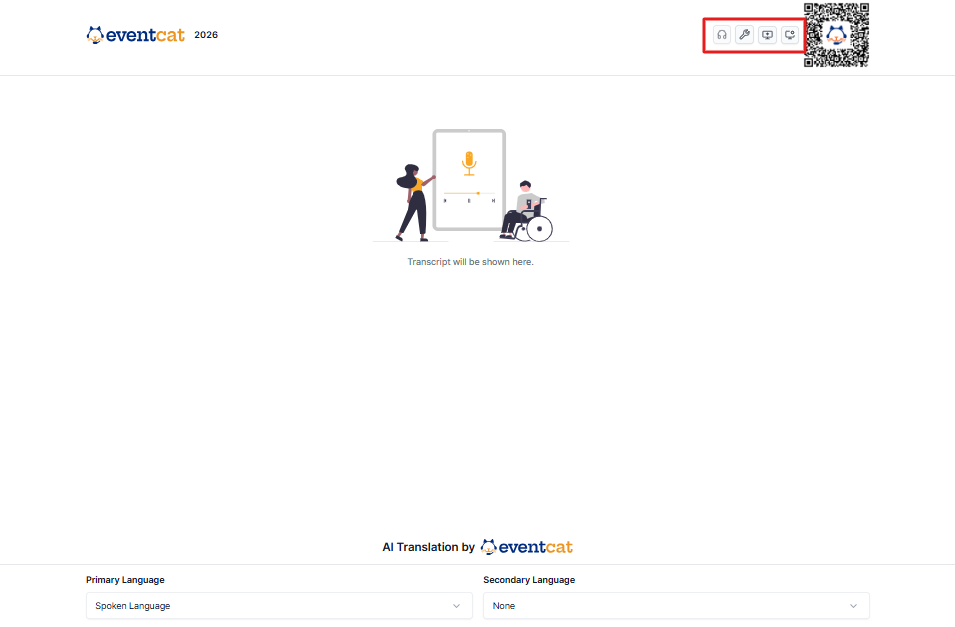
In the settings menu, you can adjust the following:
Font size
Background color
Presentation mode
Note: These features may only be available with certain passes like Half-Day Pass, All-Day Pass and All Day MAX Pass.
Important: Ensure your internet connection and audio/microphone settings are properly configured.
Related Documents:
How to Improve Live Captions and Translations with the STT Revise Guide
How to Check Audio/Microphone Recognition When Using EventCAT Conference
What Internet and Wi-Fi Environment is Needed to Use EventCAT Real-Time Translation Subtitles?
6. Running AI Translation Subtitles in the Actual Event
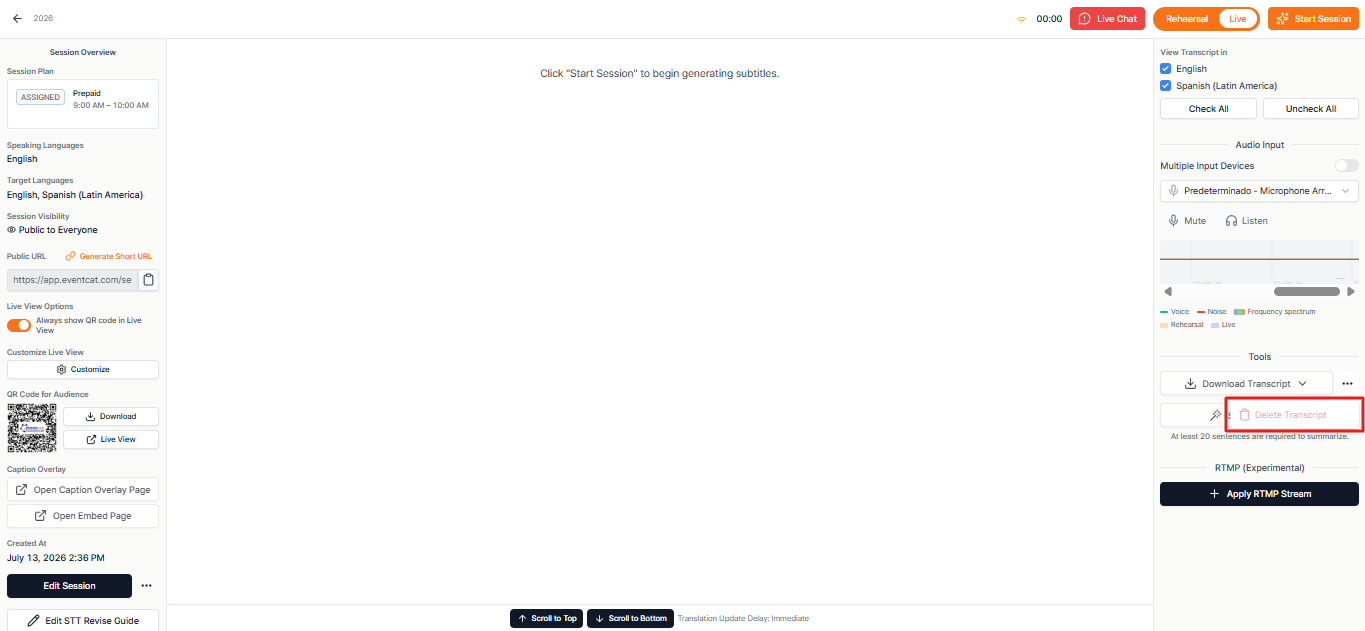
Once the rehearsal is complete:
End the session and, if necessary, clean up the rehearsal data.
Click the Live button in the top-right corner of the controller page to begin the actual event.
Click Start Session, and the actual event will begin.
Frequently Asked Questions
Difference Between Public and Private Mode and How to Set It
EventCAT On-Site Setup Guide: How to Connect Audio and Display Captions at Your Offline Event
How to Display Both Presentation Screen and Subtitles Simultaneously
7. Subtitle Broadcasting and Screen Setup Guide for Smoother Event Operation
In actual events, it’s essential to decide in advance how to broadcast real-time translated subtitles and how the audience will view them. EventCAT Conference allows you to provide subtitles in various ways, such as on-site screens, personal devices, or live streaming, depending on the event environment. Screen settings can also be adjusted to match the event's purpose.
Displaying Subtitles on the On-Site Screen
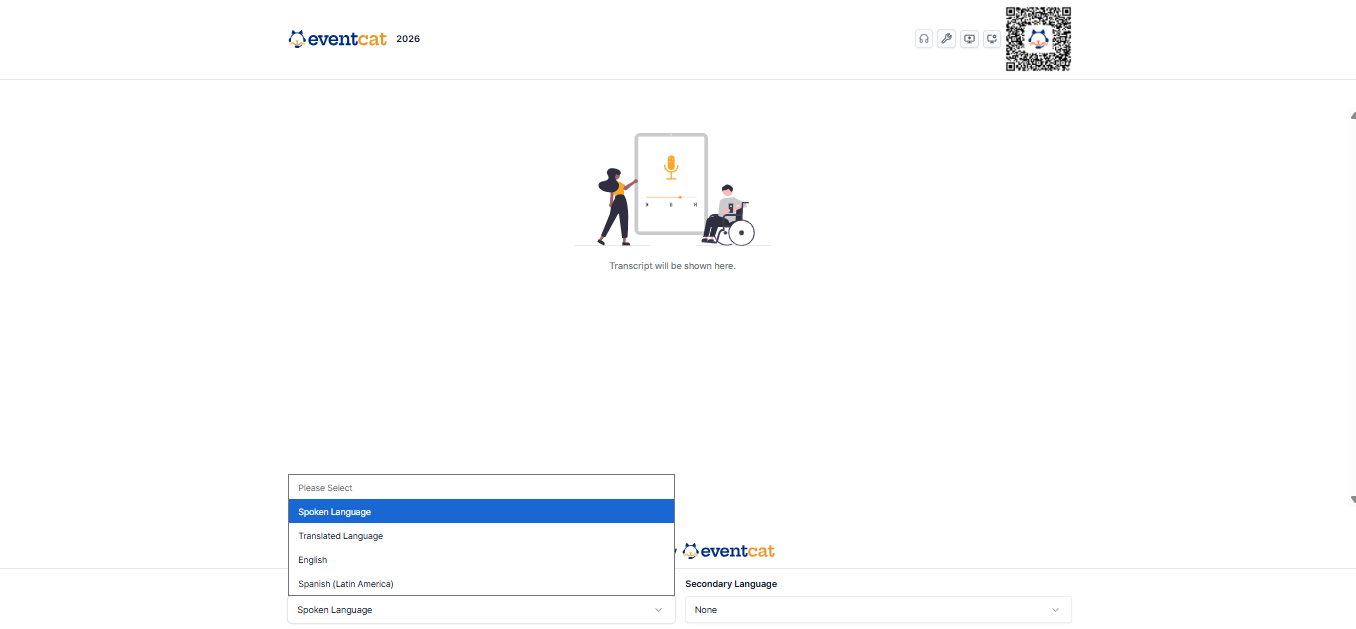
To display real-time captions and translated subtitles on the event screen, click Live View on the controller page. The Live View will open in a new window.
At the bottom of the screen, use the language dropdowns to select up to two languages. For sessions configured with exactly two target languages, you can also select Spoken Language to display the language currently being spoken or Translated Language to display the translation in the other language.
The system detects the spoken language and switches the displayed content automatically, so no manual changes are needed during the session. Text-to-speech is disabled for panels using these dynamic options.
Display the Live View window on the event hall’s screen so attendees can follow the real-time captions and translations.
Viewing Subtitles on Personal Devices via QR Code or URL
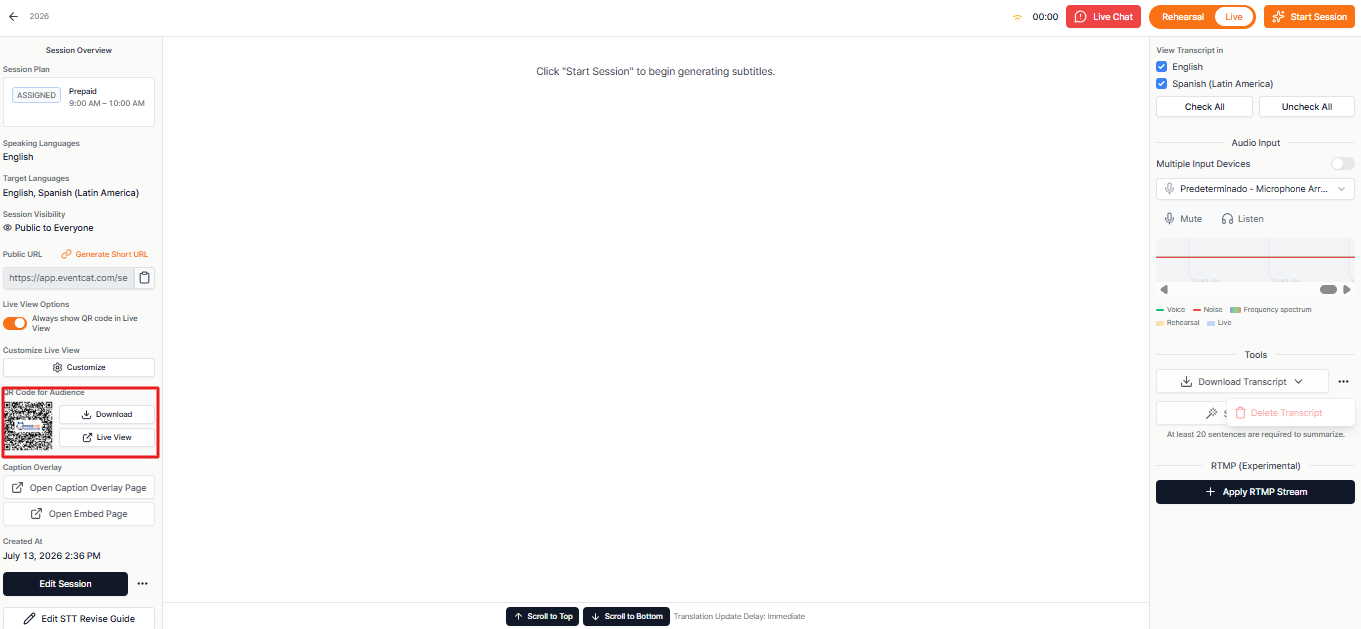
To allow participants to view subtitles on their personal devices (smartphones, tablets, laptops, etc.), the session must be set to Public.
From the controller page, you can view or download the participant URL and QR code. By placing this QR code on the event screen, informational banners, printed materials, or name tags, participants can access it directly and choose the language they wish to view or hear.
If you share the QR code in advance before the event, the on-site operation will be much smoother.
Applying Subtitle Overlay for Live Broadcast or Online Streaming
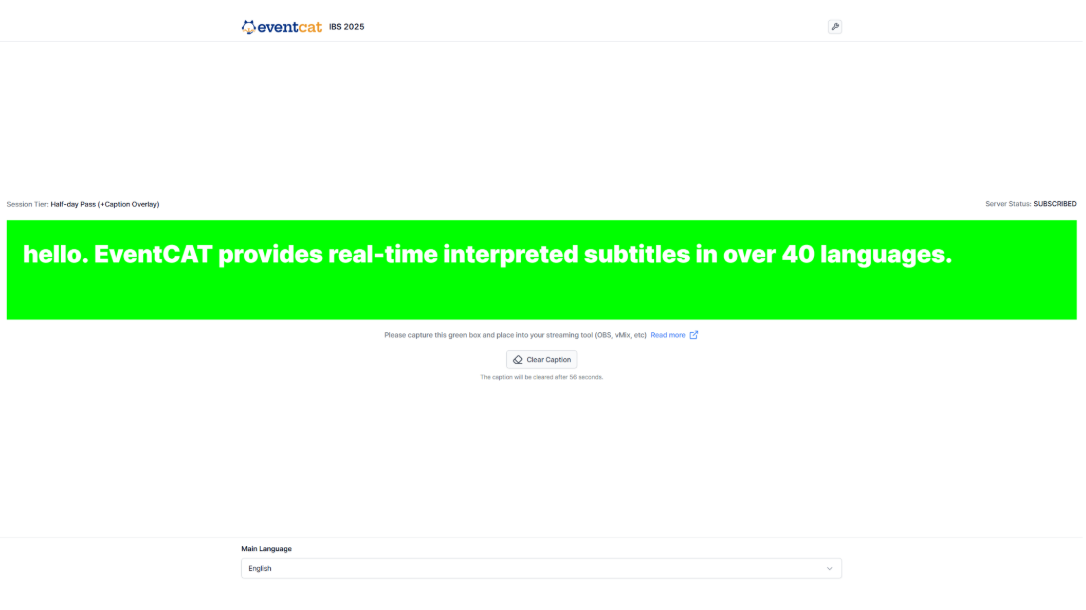
If you need to broadcast subtitles on top of a video in a live broadcast or online streaming environment, such as YouTube, OBS, or Zoom, you can use the Caption Overlay feature.
With this feature, you can stream real-time translated subtitles as an overlay, allowing online viewers to watch the event with subtitles included.
Note: The caption overlay feature is available with the All-day MAX pass.
Enhancing Audience Engagement with Screen Settings
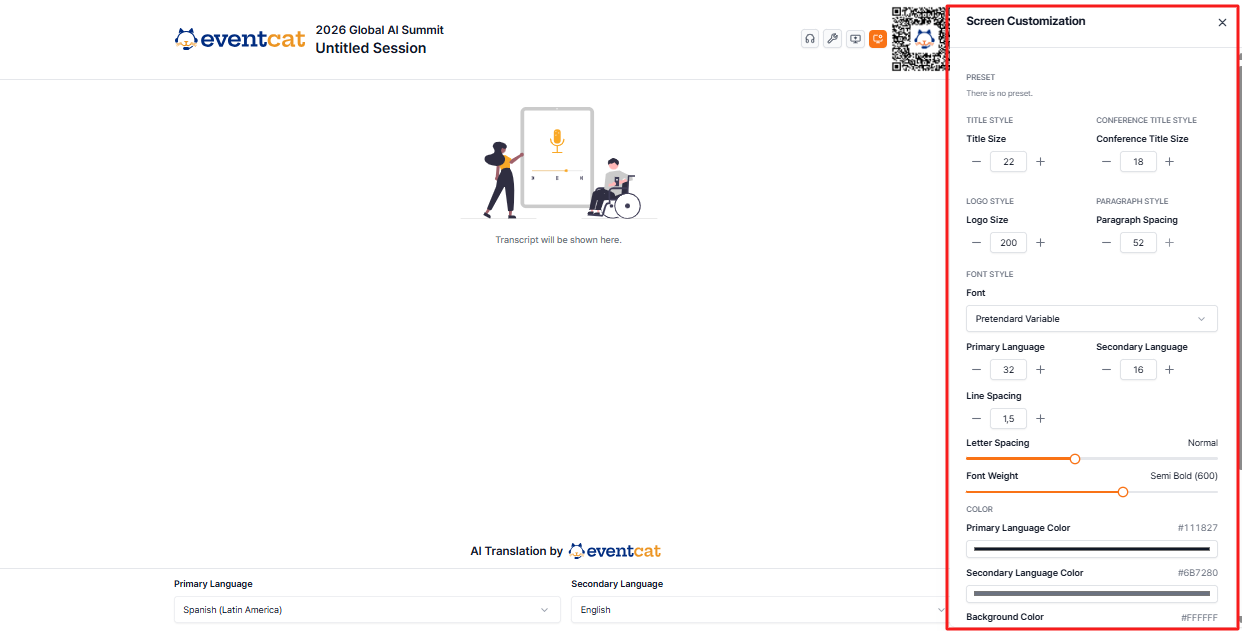
In the settings menu on the top right of the live view page, you can adjust the subtitle display to match the event environment.
This host-only feature gives you complete control over the appearance and layout of the Live View:
Preset: Apply an available saved configuration.
Title and Conference Title: Adjust their style and text size.
Logo: Customize the logo style and display size.
Paragraph Style: Control the spacing between subtitle paragraphs.
Layout: Show or hide the header and footer, adjust the content width, and set the top, bottom, left, and right padding.
Font Style: Select the font and configure the primary and secondary language sizes, line spacing, letter spacing, and font weight.
Live View Fade: Enable or disable the fade effect around the subtitle area.
Colors: Customize the primary language, secondary language, background, and border colors.
Language Backgrounds: Add language backgrounds and assign a different background color to each language.
Use the step controls to fine-tune layout values. When the header is hidden, move the cursor to the top of the screen to display it temporarily.
Click Save to keep the customization after refreshing or reopening Live View, or select Reset to restore the settings. These controls help you create a clear, consistent, and audience-friendly subtitle experience for any presentation environment.
Listening to Real-Time Translation via Audio
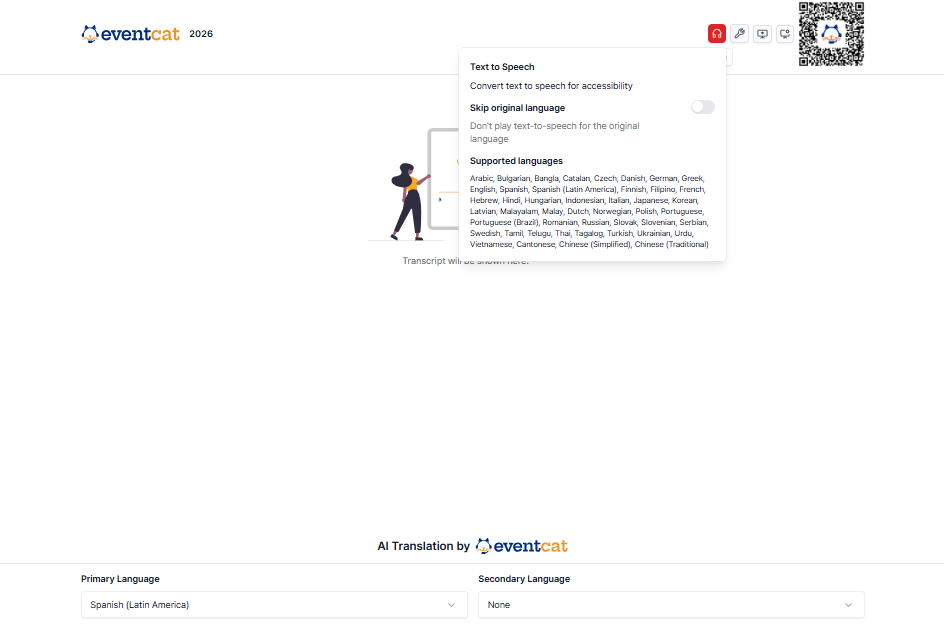
EventCAT also supports Text-to-Speech (TTS) functionality in addition to subtitles. After accessing via QR code, participants can connect headphones or a headset to their personal device to listen to the translated content in their preferred language.
This feature is particularly useful for environments where reading subtitles is difficult or for audiences who prefer to follow the content by listening.
Double-Check Microphone Input Before the Event
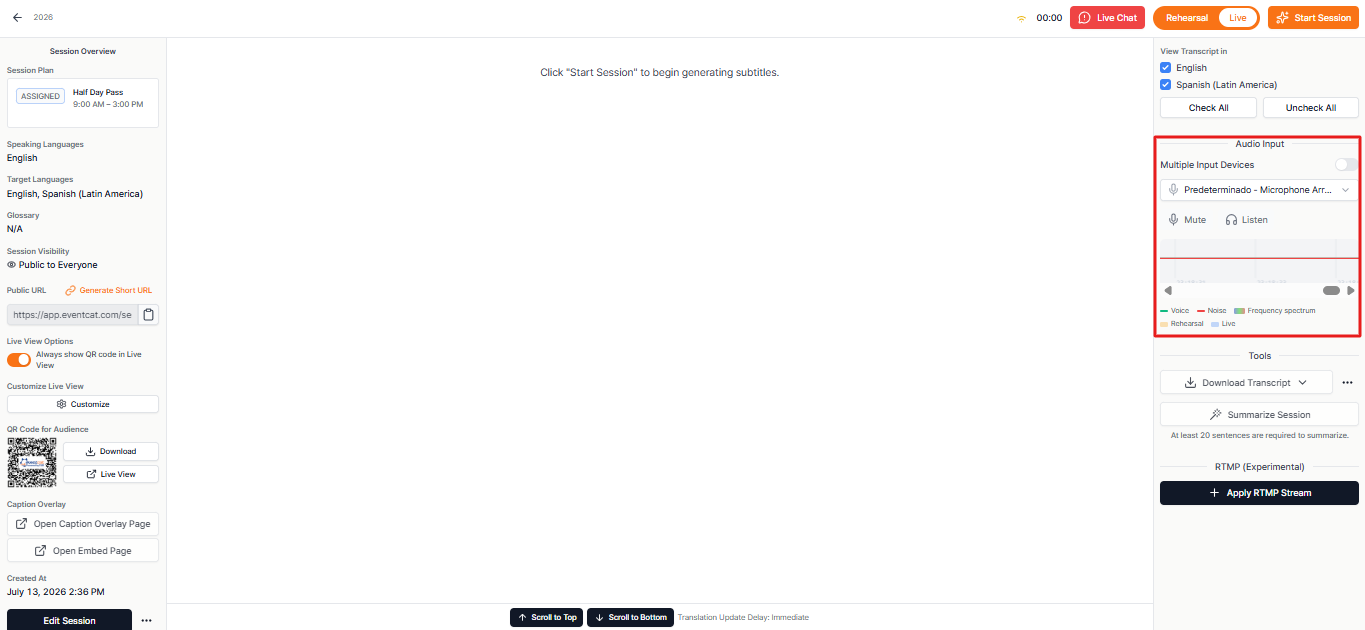
Use the Audio Input panel to confirm that your session is receiving a clear and stable audio signal before going live.
Select the microphone you want to use and watch the real-time volume and noise graph to verify that the speaker can be heard without excessive background noise. Use Listen to monitor the selected input through an output device, and use Mute whenever you need to pause audio transmission without disconnecting the microphone.
For the best results, keep the audio level consistent and make sure the speaker’s voice is clearly visible on the live graph. A well-balanced input helps EventCAT deliver faster, clearer captions and more reliable translations throughout the session.
How to Connect your Microphone(s):
Connect the audio interface to the laptop using a USB or A-to-C adapter.
Connect the microphone to the audio interface.
In your system’s audio settings, ensure the microphone is correctly recognized and selected.
Using the Transcript and Summary After Session Ends
After the event ends, you can close the session in the controller and organize the transcript and summary.
Available Actions After Session Ends:
Download the transcript in different languages or the entire transcript.
Delete the transcript if needed.
Create and download session summaries based on translated languages.
This functionality helps organize event records or prepare internal materials for sharing.
Starting Real-Time AI Simultaneous Interpretation in Your Event
Once the EventCAT Conference setup is complete, you can start operating real-time AI simultaneous interpretation for your event.
For more stable operation, we recommend thoroughly testing in rehearsal mode before going live.
Setting Up the Conference and Starting the Event
Start EventCAT AI Simultaneous Interpretation Solution Today:
For demo inquiries related to international events, corporate events, conferences, academic conferences, and educational institutions, contact us at: contact@eventcat.com
Need More Help?
Go to EventCAT Help Center
Was this article helpful?
That’s Great!
Thank you for your feedback
Sorry! We couldn't be helpful
Thank you for your feedback
Feedback sent
We appreciate your effort and will try to fix the article